

You have the meditation apps. You go for walks at the Greensboro Arboretum to clear your head, and you try to get enough sleep. But even with your best self-care efforts, that heavy feeling just won’t give. If you are nodding in agreement, these could be signs you need therapy.
Professional therapy is recommended when your emotional state or behaviors consistently interfere with your daily life, relationships, or work performance. While self-care helps you maintain your wellness, therapy provides the clinical tools needed to address deep-seated patterns that you cannot fix through lifestyle changes alone.e
Key Takeaways
- Self-care is maintenance; therapy is repair. Self-care helps you manage daily stress, while therapy addresses the underlying causes of persistent emotional struggles.
- Interference is a major indicator. If anxiety, low mood, or burnout prevents you from functioning at work or home, it is time to seek professional help.
- Crisis is not required. You do not need to hit rock bottom to benefit from therapy; proactive care prevents minor “burns” from becoming full-scale burnout.
- Accessibility has changed. Modern therapy in the Piedmont Triad now offers no waitlists and evening appointments to fit your busy life.
Is Your Self-Care Working? A Quick Self-Check
If you are unsure whether your current habits are sufficient, ask yourself these six questions. If you answer “yes” to three or more, professional counseling could help you reignite hope.
- Do I feel exhausted even after a full night of sleep or a relaxing weekend?
- Have I withdrawn from friends or family in Greensboro or High Point because socializing feels like too much work?
- Do I find myself snapping at coworkers or loved ones over minor inconveniences?
- Am I using habits (like scrolling, drinking, or overworking) to numb my feelings rather than manage them?
- Do I feel like I am “just going through the motions” of my life?
- Has a partner or friend expressed concern about my well-being lately?
What Self-Care Is Actually Good For
Self-care is a vital practice for maintaining mental hygiene, much like brushing your teeth is for physical health. It includes the daily habits like exercise that help regulate your nervous system and keep stress levels manageable. When you are in a healthy place, these activities “feed your flame” and keep you resilient.
The Limits of Going It Alone
The limit of self-care is reached when you are trying to use “maintenance” tools to fix a “structural” issue. If you are struggling with a trauma, a high-conflict marriage, or clinical depression, a bubble bath or a gym session cannot provide the emotional processing required for healing. Pushing yourself to “just do more self-care” when you actually need therapy can lead to a sense of failure.
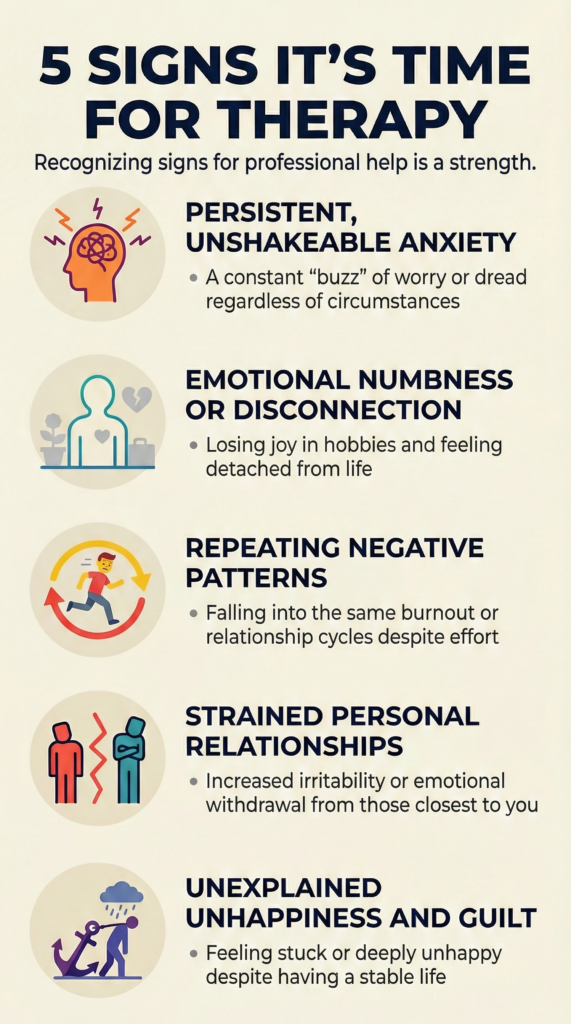
5 Signs You Need Therapy
Recognizing the signs you need therapy is not a sign of weakness; it is an act of self-awareness. Here are five indicators that it is time to transition from self-care to clinical support.
- Persistent Anxiety That Does Not Lift: You feel a constant “buzz” of worry or a sense of impending doom that follows you from your morning coffee to your late-night scroll, regardless of how “good” your day was.
- Emotional Numbness or Disconnection: You no longer feel the “spark” of joy in activities you used to love, and you feel like you are viewing your life through a thick pane of glass.
- Same Patterns Repeating Despite Effort: You keep having the same argument with your partner or falling into the same cycle of burnout at work, even though you have read all the books and tried to change.
- Relationships are Suffering: You are increasingly irritable, or you have started to “stonewall” those closest to you because you simply do not have the emotional capacity to engage.
- The Feeling of “I Should Be Fine by Now”: You have a good life, a stable job in the Triad, and a supportive family, yet you still feel deeply unhappy or stuck, leading to a secondary layer of guilt for feeling that way.
When “I Should Be Fine by Now” Becomes a Red Flag
That phrase is often the biggest barrier to getting help. Many high-achieving professionals in Greensboro and High Point tell themselves they don’t have it “bad enough” to deserve therapy. However, mental health does not require a minimum threshold of suffering. If your internal experience does not match your external reality, that disconnect is a signal that your internal “flame” needs professional tending.
Not sure if what you’re feeling qualifies? A quick conversation with one of our therapists can help you figure that out. No waitlist, no pressure.
Had a Frustrating Therapy Experience Before? This Time Can Be Different
If you have tried therapy before and felt it wasn’t helpful or that your therapist didn’t “get” you, we understand why you are skeptical. A bad fit can make you feel more misunderstood than when you started. At Emberhaven, we believe the friction of waitlists and rigid scheduling shouldn’t be harder than the problem that brought you there.
We focus on matched connections. Our Greensboro and High Point locations are designed to feel like a warm haven, not an institution. We match you with a therapist based on your specific needs, whether you are a teacher checking her phone between classes or a nurse finishing a 12-hour shift.
What Therapy Offers That Self-Care Can’t
While self-care offers temporary relief, evidence-based therapy provides practical skills and real-world tools that create long-term change. We use methods that are grounded in clinical research to help you gain agency over your life.
| Feature | Self-Care | Professional Therapy |
| Focus | Symptom management and relaxation | Root cause identification and behavioral change |
| Guidance | Self-directed | Facilitated by a licensed clinician |
| Tools | Lifestyle habits (sleep, diet, exercise) | CBT, DBT-informed skills, ACT, Gottman Method |
| Accountability | Personal willpower | Structured professional support and clear goals |
Real-World Tools, Not Just Coping Strategies
We empower you with specific frameworks like Cognitive Behavioral Therapy (CBT) to challenge intrusive thoughts, or Acceptance and Commitment Therapy (ACT) to help you live according to your values even when things are hard. For couples, we use the Gottman Method and EFT-informed techniques to turn conflict into connection. These aren’t just “coping” mechanisms; they are specialized tools to help you rebuild your foundation.
Finding Therapy That Actually Fits Your Life
You are busy, and your time is valuable. That is why we have removed every barrier to entry for residents in the Piedmont Triad. You shouldn’t have to call ten practices and wait three months to be seen.
- Greensboro and High Point Locations: Conveniently located for easy access during your day.
- Radically Accessible: We offer lunch-hour and evening appointments because your mental health shouldn’t depend on taking a day off work.
- No Waitlists: When you’re ready to “feed your flame,” we are ready to see you—often within the same week.
- Telehealth Across North Carolina: If you can’t make it to an office, we bring the haven to you through secure, practical virtual sessions.
FAQ
What are the signs that self-care isn’t enough and I need a therapist? The clearest signs include feeling “stuck” despite your best efforts, experiencing symptoms that interfere with your job or relationships, or using unhealthy habits to numb your stress. If your emotional state has remained the same or worsened over a two-week period, it is time for professional support.
What’s the difference between self-care and therapy? Self-care is a proactive way to stay healthy, whereas therapy is a clinical intervention. Therapy involves a licensed professional using evidence-based tools (like CBT or ACT) to help you process trauma, manage clinical anxiety, or change deep-seated behavioral patterns that self-care cannot reach.
Can therapy help if I’m not in crisis—just stressed or burned out?
Yes, therapy is highly effective for burnout and high-stress situations. You do not need to be in a crisis to seek help; in fact, starting therapy when you first notice burnout can prevent a more serious mental health crisis later.
What if I’ve tried therapy before and it didn’t help?
Therapeutic success relies heavily on the “fit” between you and your counselor. At Emberhaven, we focus on matching you with the right clinician and removing the bureaucratic friction that often makes therapy feel like a chore rather than a resource.
What should I expect from my first therapy appointment?
Expect a warm, welcoming environment where your therapist will listen to your concerns and help you set clear, practical goals. We won’t just talk about your feelings; we will begin identifying the real-world tools you can use to start making progress immediately.
Does insurance cover outpatient therapy in North Carolina?
Yes, most major insurance plans cover outpatient mental health services. We offer instant insurance verification so you know exactly what your coverage looks like before your first session.
Take the Next Step
You have already done the hard part—recognizing that something needs to change. Let us handle the rest. Whether you are looking for support for yourself, your teen, or your marriage, we are here to help you rise and reclaim your energy.
Evening and lunch-hour appointments available at our Greensboro and High Point locations. Check your insurance in minutes and book your first visit today.
Safety Resources
If you are in an immediate crisis, please use the following resources:
- SAMHSA National Helpline: 1-800-662-HELP (4357)
- National Suicide Prevention Lifeline: 988
- Crisis Text Line: Text HOME to 741741