

Yes. Therapy in North Carolina is confidential. What you say in a session stays between you and your therapist and doesn’t go to your employer, your insurance company’s claim department, or your family. It is between you and your therapist.
There are a small number of legal exceptions, and you deserve to know exactly what they are before you ever sit down on the couch.
North Carolina Therapists at Emberhaven are bound by state and federal HIPAA regulations to protect your privacy. Although sessions are confidential, there are some exceptions to privacy, but they are almost certainly not something you’re worried about.
Key Takeaways
- Therapy sessions in NC are legally protected as confidential under HIPAA and North Carolina state law.
- Your employer cannot find out you’re in therapy, and your insurer cannot access session content, only basic billing codes if you use insurance.
- Therapists can break confidentiality only in three situations: imminent risk of harm, mandatory abuse reporting, or when you authorize it yourself.
- Telehealth sessions carry the same legal protections as in-person sessions when the platform is HIPAA-compliant.
- You have the right to ask any therapist about their privacy practices before your first appointment. A good therapist will welcome the question.
What “Therapy Is Confidential” Actually Means
Confidentiality in therapy isn’t a courtesy. It’s a legal obligation for mental health privacy. Your therapist is prohibited from disclosing what you share in sessions without your written consent. That protection covers everything: what you talk about, that you’re a client at all, even whether you showed up for an appointment.
This matters because therapy only works when people feel safe saying things they’ve never said out loud before. North Carolina’s privileged communications statutes and HIPAA both exist to make that safety real, not theoretical.
In North Carolina, your therapy sessions are protected by a powerful combination of federal HIPAA regulations and strict state privacy laws. Under HIPAA, your therapist is legally bound to keep your Protected Health Information (PHI), which includes your diagnosis, treatment plan, and the private details you discuss—completely confidential. In fact, HIPAA grants an extra, specialized layer of protection specifically for “psychotherapy notes,” meaning they are kept separate from your general medical record and usually cannot be shared with insurance companies or other doctors without your explicit written authorization.
North Carolina law heavily reinforces this federal baseline, making it a misdemeanor for mental health professionals to share your information without your consent. The only times a therapist can legally break this confidentiality are in extreme safety situations, such as an imminent threat of harm to yourself or others, suspected abuse of a child or vulnerable adult, or a direct court order from a judge.
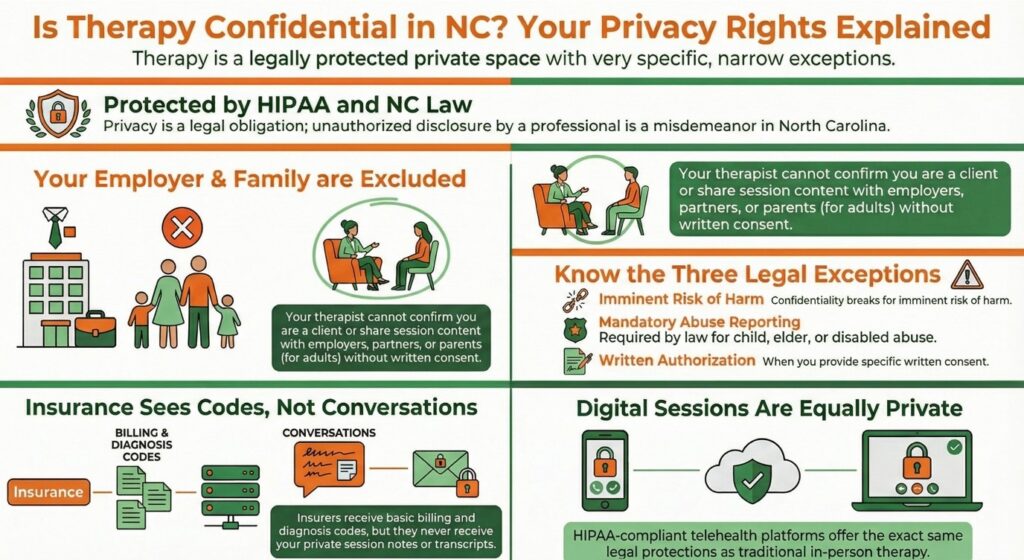
What Your Therapist Can and Cannot Share
Your therapist cannot share your session content with your employer, your partner, your parents (if you’re an adult), or anyone else who calls asking about you without your explicit written authorization.
Your therapist can share information if you sign a release form. You control that completely. Some clients sign releases so their therapist can coordinate care with a psychiatrist or primary care doctor. That’s your choice to make.
What your therapist will document includes session notes, diagnoses, treatment plans, and billing information. You have the right to request a copy of your own records at any time.
Why Confidentiality Looks Different in Individual Counseling vs. Psychiatry or Group Therapy
In individual counseling, the privacy circle is tight: you, your therapist, and anyone you’ve authorized in writing.
Psychiatry involves prescribing, which means more coordination with other providers and more insurance communication around medication management. The content of your sessions is still protected, but your medication history and diagnoses move through healthcare systems in ways your therapy notes don’t.
Group therapy is its own situation. Your therapist is bound by confidentiality, but other group members are not. Reputable programs ask members to sign confidentiality agreements as a condition of participation. Ask about this before you join.
The Exceptions: When a Therapist Can Break Confidentiality
There are three situations where a North Carolina therapist is legally required (or permitted) to share information without your consent. All three are narrow.
Imminent Risk of Harm to Yourself or Others
If a therapist believes there is a specific, credible, imminent threat that you will harm yourself or someone else, they are permitted and in some cases required to take protective action. This might mean contacting a crisis service, notifying a potential victim, or facilitating an emergency evaluation.
This is not a hair-trigger. Telling your therapist you’ve had thoughts of suicide does not automatically mean they’re calling 911. The bar for mandatory action is genuine imminent danger, not distress, not dark thoughts, not past history. Many people discuss suicidal ideation in therapy without any breach of confidentiality.
Mandatory Reporting for Child or Elder Abuse
North Carolina law requires therapists, along with teachers, doctors, and other mandated reporters, to report suspected abuse or neglect of a child, a disabled adult, or an elderly person. This obligation exists to protect people who can’t protect themselves. It applies when there is reasonable cause to suspect ongoing or past abuse, not theoretical risk.
When You Authorize the Release Yourself
This is the most common situation, and it’s not really an exception at all. It’s you exercising control. If you sign a release of information, your therapist can share what the release specifies with whoever you’ve designated: a physician, a school counselor, an attorney, a family member. You decide the scope and the duration.
Still have questions about what starting therapy actually looks like? At Emberhaven, we’re happy to answer them before you ever book a session. No commitment, no pressure. Reach out anytime.
Does Insurance Complicate Your Privacy?
Using insurance for therapy does involve sharing some information, but probably less than you think.
What Your Insurance Company Sees and What They Don’t
When you use insurance, your therapist submits a diagnosis code and a billing code for the session type. That’s what the insurance company receives. They do not receive your session notes or anything resembling a transcript of what you discussed.
Your employer’s HR department does not have access to your insurance claims, even if your employer provides your health insurance. That’s a separate legal protection under HIPAA.
The tradeoff is that a diagnosis code lives in your medical record. For most people, that’s acceptable. But if you have specific concerns (credentialing implications, for instance), paying out of pocket removes even that layer. Many therapists offer sliding-scale fees for this reason.
Confidential Therapy in the Greensboro and High Point Area
If you’re in the Piedmont Triad and privacy is part of what’s been keeping you from starting therapy, that’s worth naming, because it’s more common than people let on. The idea that someone at work or a family member might find out can feel like a real obstacle. It doesn’t have to be.
How Emberhaven Protects Your Privacy from Day One
At Emberhaven, privacy isn’t just a legal checkbox. It’s part of how we treat people. Our Greensboro and High Point offices are calm and private, set up so that running into someone you know doesn’t feel like a risk you’re taking.
Intake is simple and discreet. Insurance verification happens quickly, so you know what to expect financially before your first session. Evening and lunch-hour appointments mean you can schedule around your life without explaining to anyone why you need time off. And when the right therapist is matched to you rather than just the next available slot, sessions feel safer faster.
Is Telehealth Therapy Private? What to Know in the Piedmont Triad
Telehealth therapy carries the same legal confidentiality protections as in-person sessions, with one practical condition: the platform your therapist uses has to be HIPAA-compliant. Consumer video apps like FaceTime or standard Zoom are not. Platforms built for healthcare are.
At Emberhaven, telehealth sessions run through a secure, HIPAA-compliant platform. Your session isn’t being recorded or stored in a consumer cloud. In a private space, telehealth can feel more private than an in-person visit. No one sees you pull into a therapist’s parking lot.
FAQs About Therapy Confidentiality in NC
Can my employer find out I’m seeing a therapist in North Carolina? No. HIPAA prohibits insurers from sharing individual claims data with employers. Unless you tell someone at work yourself, they won’t know.
Will my therapist tell my parents what I say in sessions? If you’re 18 or older, no. Your sessions are confidential from your parents, same as any other adult’s. If you’re a minor, therapists typically work with teens to establish what gets shared with parents and what stays private.
What happens if I tell my therapist I’m thinking about hurting myself? Your therapist will talk with you about it. That’s the first step, not an alarm. Therapists assess risk rather than react to words. Disclosing suicidal thoughts does not automatically trigger a call to anyone. Many people work through suicidal ideation in therapy without any breach of confidentiality.
Does using insurance affect my therapy confidentiality? Partially. Your insurer receives a diagnosis code and session type for billing. Session content stays private. If eliminating any documentation matters to you, paying out of pocket is worth asking about.
Can a therapist share my records without my permission in NC? Only in the situations covered above: imminent risk of harm, mandatory abuse reporting, or a court order. Outside of those, sharing your records without written authorization is a HIPAA violation.
Is telehealth therapy just as confidential as in-person sessions? Yes, provided the platform is HIPAA-compliant. The legal protections are identical. Practical privacy depends on your environment on your end of the call.
What should I ask a therapist about their privacy policy before my first session? A few good questions: What platform do you use for telehealth? What information do you share with my insurance company? Under what circumstances would you break confidentiality? A therapist who answers these clearly is probably someone worth trusting with the harder stuff.
Are there any situations where an NC therapist is required to report what I say? Yes, two. Suspected abuse of a child, disabled adult, or elderly person triggers a mandatory report. And if you present a specific, credible, imminent threat to someone’s safety, your therapist has a duty to act. Both are specific legal thresholds, not general worry.
Ready to Start?
When you’re ready, getting started at Emberhaven takes one step: no waitlist, no runaround, just a real appointment with the right therapist.
Emberhaven has two convenient locations in North Carolina.
Greenboro:
High Point:
Helpful Links
If you or someone you know is in crisis, please reach out:
- North Carolina Department of Health and Human Services
- SAMHSA National Helpline
- 988 Suicide & Crisis Lifeline: Call or text 988
- UNC School of Government: Confidentiality of Mental Health
- Womenslaw.org: North Carolina Confidentiality
- North Carolina Medical Board: Reporting Patient Information
- North Carolina Psychology Board